


Blog
METAL FENCING OPTIONS – IRON VS. ALUMINUM VS. STEEL
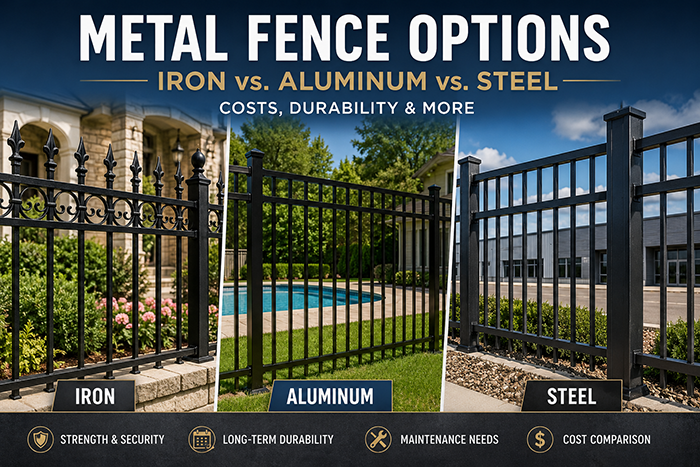
When homeowners and commercial property owners begin comparing metal fencing, three materials typically enter the conversation: iron, aluminum, and steel. At first glance, they can look remarkably similar. In practice, however, there are important differences in strength, maintenance, longevity, appearance, and cost.
Austin’s climate adds another consideration. Intense sun, periods of high humidity, heavy rain, and changing soil conditions can influence how a fence performs over the years. Choosing a metal fence should therefore involve more than selecting the design you like best.
At Capitol Fence of Austin, we install fencing for residential and commercial properties throughout Austin and Central Texas. Understanding the differences between iron, aluminum, and steel can help you choose a fence that fits your property’s appearance, security requirements, maintenance expectations, and budget.
Why Choose a Metal Fence?
Metal fencing offers something that many other fencing materials cannot: an open appearance combined with substantial strength and security. Rather than blocking the view like a traditional privacy fence, a metal fence can define and protect a property while allowing landscaping, architecture, and outdoor spaces to remain visible.
This makes metal fencing especially attractive for front yards, swimming pools, commercial properties, gated entrances, multifamily communities, and properties with views worth preserving.
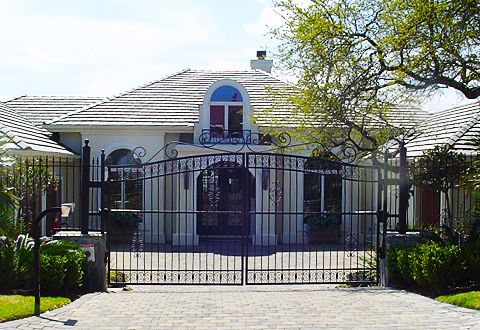
Capitol Fence offers custom ornamental iron fencing for Austin homes and businesses in a range of designs and materials, allowing the fence to become part of the property’s architecture rather than simply a boundary.
Metal fences also offer considerable design flexibility. Depending on the material and fabrication, they can range from understated contemporary fencing with clean vertical lines to more traditional ornamental designs. The first decision is determining which metal best fits the project.
Iron Fencing: Traditional Appearance and Distinctive Character
Iron fencing has long been associated with substantial homes, historic architecture, decorative entrances, and properties where the fence itself is intended to become an architectural feature.
One of iron’s greatest advantages is its appearance. It can incorporate decorative details, custom shapes, finials, curves, and other elements that can give a property a distinctive character.
Iron is also extremely strong. When properly fabricated, installed, and maintained, an iron fence can provide decades of service. That longevity does come with maintenance responsibilities. Because iron is a ferrous metal, damaged protective coatings can eventually allow rust to develop. Periodic inspection, touch-up painting, and attention to areas where the finish has been damaged help preserve the fence.
Iron fencing also tends to be one of the more expensive metal fence choices, particularly when custom fabrication or elaborate ornamental work is involved.
For property owners who value craftsmanship and traditional architectural character, custom ornamental iron fence designs that combine security with distinctive curb appeal can provide an appearance that is difficult to duplicate with lighter fencing materials.
Aluminum Fencing: Attractive and Low Maintenance
Aluminum provides the appearance of ornamental metal fencing without many of the maintenance requirements associated with traditional iron. Because aluminum does not rust in the same manner as iron or conventional steel, it can be notably appealing to homeowners looking for a lower-maintenance fence. Factory-applied finishes further protect the material and provide a clean, consistent appearance.
Aluminum is also relatively lightweight. That can simplify handling and make it suitable for many residential applications. It is frequently considered for pools, landscaped yards, gardens, and residential properties where the goal is to establish a defined boundary without unnecessarily obstructing the view.
The tradeoff is strength. Aluminum generally does not provide the same level of impact resistance or structural strength as heavier steel or iron fencing. For a residential decorative boundary, that may not matter. For a commercial property or location calling for substantial perimeter security, it can become an important consideration.
Steel Fencing: Strength with Contemporary Versatility
Steel occupies an interesting position between traditional iron and lightweight aluminum.
It provides excellent strength and can be manufactured in both traditional ornamental styles and clean contemporary designs. This versatility makes steel appropriate for residential properties as well as demanding commercial and industrial installations.
Modern steel fencing can also be protected with coatings designed to resist corrosion and weather exposure. Proper coating quality and installation remain important because damage that exposes bare steel can eventually lead to corrosion.
Where steel particularly distinguishes itself is security. Its strength makes it an ideal choice for properties where the fence must do more than provide visual separation.
Commercial buildings, apartment communities, controlled-access properties, schools, equipment areas, and other facilities can benefit from the combination of attractive design and substantial perimeter protection that steel provides. Capitol Fence offers commercial ornamental iron and steel fencing designed for perimeter security for a variety of business and institutional applications.
Iron vs. Aluminum vs. Steel: Which Is Best?
There is no single best metal fence material for every property. Iron is often best when traditional appearance, custom fabrication, and substantial construction are priorities. Aluminum is particularly attractive when low maintenance and ornamental appearance matter most. Steel is frequently preferred when strength, security, and long-term structural performance are primary considerations.
The right choice depends on where the fence will be installed and what it needs to accomplish. A decorative front-yard fence and a commercial security perimeter may look somewhat similar, but their performance requirements can be dramatically different.
Iron vs. Aluminum vs. Steel: How Do Costs Compare?
There isn’t a single per-foot price that accurately represents every metal fence project. Fence height, grade, style, post requirements, gates, property conditions, finish, decorative elements, and installation complexity can substantially affect the final price.
As a general comparison, aluminum can be an economical option when a property owner wants the appearance of ornamental fencing without extensive maintenance or custom fabrication. Steel can range considerably in price depending on the gauge, design, coating, and security requirements. Custom iron fencing will typically require a larger investment, particularly when the project incorporates extensive ornamental fabrication.
Initial price should not be the only consideration. A lower-cost fence that doesn’t provide the required strength or appearance isn’t necessarily the better value. Conversely, paying for a heavier security-oriented system when a decorative residential fence will meet every requirement may be unnecessary. The better comparison is lifetime value based on how the fence will actually be used.
Which Metal Fence Is the Most Durable?
All three materials can provide excellent longevity when properly manufactured, installed, and maintained, but durability means different things depending on the application.
- For corrosion resistance and minimal maintenance, aluminum has an advantage.
- For physical strength and impact resistance, steel is generally the stronger choice.
- Iron combines substantial construction and traditional craftsmanship although typically requires more maintenance to protect against corrosion.
This is why material selection should begin with the property and its requirements rather than simply asking which metal is “best.” Homeowners comparing metal fencing with other options can also explore residential fencing styles for different privacy, safety, and architectural requirements before making a final material decision.
Which Metal Fence Requires the Least Maintenance?
For property owners primarily concerned about reducing ongoing maintenance, aluminum is generally the simplest of the three materials to maintain. It does not require the same level of rust prevention associated with ferrous metals, and quality finishes require relatively little routine attention.
Steel fencing with a high-quality protective coating can also be relatively easy to maintain. Owners should routinely inspect the finish, particularly around gates, fasteners, welds, and locations susceptible to impact or abrasion.
Iron typically requires the greatest attention. Small areas of rust need to be treated before corrosion spreads beneath the surrounding finish.
Regardless of material, periodically inspecting the fence and gate hardware can identify minor problems before they develop into expensive repairs.
What About Metal Fencing Around a Swimming Pool?
Metal fencing can be an excellent choice around swimming pools because it can provide a protective barrier without visually separating the pool from the surrounding backyard.
Aluminum and ornamental steel are especially well suited to applications where homeowners want to preserve visibility into the pool area while creating a defined enclosure.
Pool fencing, however, is fundamentally a safety installation. Fence height, picket spacing, gates, latches, and other details must comply with applicable requirements. Appearance should never take priority over proper pool barrier design.
Matching Metal Fencing with Automatic Gates
Metal fencing and driveway gates naturally complement one another, particularly when the fence is planned as an integrated system. A custom metal driveway gate can match the fence’s picket spacing, profile, decorative elements, and finish. Automatic gate operators, access controls, keypads, intercoms, and other technology can then be incorporated according to how the property is used.
Material and construction become particularly important with automated gates because gate weight, dimensions, wind exposure, hinges, posts, and operator requirements all affect performance. Planning an automatic gate system integrated with the property’s fencing and landscaping generally produces a more cohesive appearance and better-performing entrance than treating gate automation as an afterthought.
Residential vs. Commercial Metal Fencing
A homeowner may primarily be concerned with curb appeal, pets, children, pool safety, or maintaining an attractive view. A commercial property owner may be much more concerned with perimeter security, traffic control, durability, and restricting unauthorized access.
Those different objectives can point toward different materials. Aluminum can be an excellent solution for residential properties when appearance and low maintenance are priorities. Iron can complement distinctive architecture and custom residential entrances. Steel can provide the additional strength demanded by commercial and higher-security applications while still offering an attractive finished appearance.
There is no reason, however, to make these categories absolute. The right material is determined by the requirements of the individual property.
Choosing the Right Metal Fence for Your Austin Property
When comparing iron, aluminum, and steel, consider five primary factors: appearance, security, maintenance, budget, and expected service life.
If your priority is traditional character and custom craftsmanship, iron deserves serious consideration. If you want an attractive ornamental style with minimal maintenance, aluminum may be the better solution. If strength and security are particularly important, steel can provide an excellent balance of appearance and performance.
The quality of the installation matters just as much as the material. Proper post installation, accurate alignment, dependable gate construction, appropriate hardware, and careful attention to site conditions all contribute to how well a metal fence performs over time.
Property owners who are still comparing materials and configurations can explore residential and commercial fencing products for different property requirements before narrowing the project to a specific metal, design, or gate configuration.
Metal Fencing Designed for Central Texas Properties
A metal fence can become an important architectural feature rather than simply a boundary around your property. The right design can improve security, define outdoor areas, complement landscaping, enhance an entrance, and add lasting curb appeal.
Capitol Fence of Austin helps homeowners, businesses, property managers, and contractors evaluate metal fencing based on how a property actually needs to function.
From ornamental residential fencing and pool enclosures to commercial perimeter fencing and automatic entry gates, our goal is to match the right materials and design with each project’s specific requirements.
If you’re considering iron, aluminum, or steel fencing for an Austin-area property, Capitol Fence of Austin can help you compare the options and design a fence that provides the right combination of appearance, durability, security, and long-term value.
FAQ’s – ABOUT METAL FENCING OPTIONS & CONSIDERATIONS
Q: Which is better for fencing, iron, aluminum, or steel?
A: The best material depends on the property’s needs. Iron is well suited for traditional appearance and custom ornamental work, aluminum is attractive for low-maintenance residential applications, and steel is often preferred when strength and security are the primary considerations.
Q: Which metal fence is the most durable?
A: Steel generally provides the greatest physical strength and impact resistance, while aluminum offers excellent corrosion resistance. Iron can also provide decades of service when properly protected and maintained. Installation quality and protective finishes play an important role in the lifespan of all three materials.
Q: Which metal fence requires the least maintenance?
A: Aluminum generally requires the least ongoing maintenance because it does not rust like iron or conventional steel. Quality powder-coated steel can also be relatively low maintenance, while iron typically requires more frequent inspection and attention to damaged finishes.
Q: Is aluminum fencing strong enough for residential properties?
A: Yes. Aluminum fencing can be an excellent choice for residential yards, swimming pools, landscaping, and decorative property boundaries. For areas requiring greater impact resistance or higher levels of security, steel or iron may be more appropriate.
Q: Is steel fencing a good choice for commercial properties?
A: Yes. Steel’s strength makes it particularly well suited for commercial, multifamily, institutional, and controlled-access properties. It can provide substantial perimeter security while maintaining an attractive ornamental or contemporary appearance.
Q: Does iron fencing rust in Austin’s climate?
A: Iron can develop rust if its protective coating is damaged and bare metal is exposed to moisture. Regular inspection and prompt repair of scratches or damaged finishes help protect iron fencing and extend its service life in Central Texas conditions.
Q: Which costs more, iron, aluminum, or steel fencing?
A: Costs vary considerably based on fence height, design, material thickness, finish, gates, site conditions, and installation requirements. Aluminum is often competitive for decorative residential fencing, while custom iron typically requires a larger investment. Steel pricing varies depending on the strength and security requirements of the project.
Q: What is the best metal fencing for a swimming pool?
A: Aluminum and ornamental steel are frequently considered for pool enclosures because their open designs preserve visibility while providing a defined barrier. Pool fences and gates must also meet applicable safety requirements for height, spacing, latching, and access.
Q: Can an automatic driveway gate match a metal fence?
A: Yes. Iron and steel driveway gates can be designed to coordinate with the fence’s profile, picket spacing, decorative features, and finish. Planning the automatic gate and fencing as one system can also improve appearance, structural performance, and operator compatibility.
Q: How long does a metal fence last?
A: A professionally installed metal fence can provide many years of service, and properly maintained iron and steel fences can last for decades. The actual lifespan depends on the material, protective coating, installation quality, environmental exposure, and routine maintenance.
RECENT BLOG POSTS
METAL FENCING OPTIONS – IRON VS. ALUMINUM VS. STEEL
Kid Friendly Backyard Fences: Safety & Aesthetics Combined

LATEST PROJECTS